
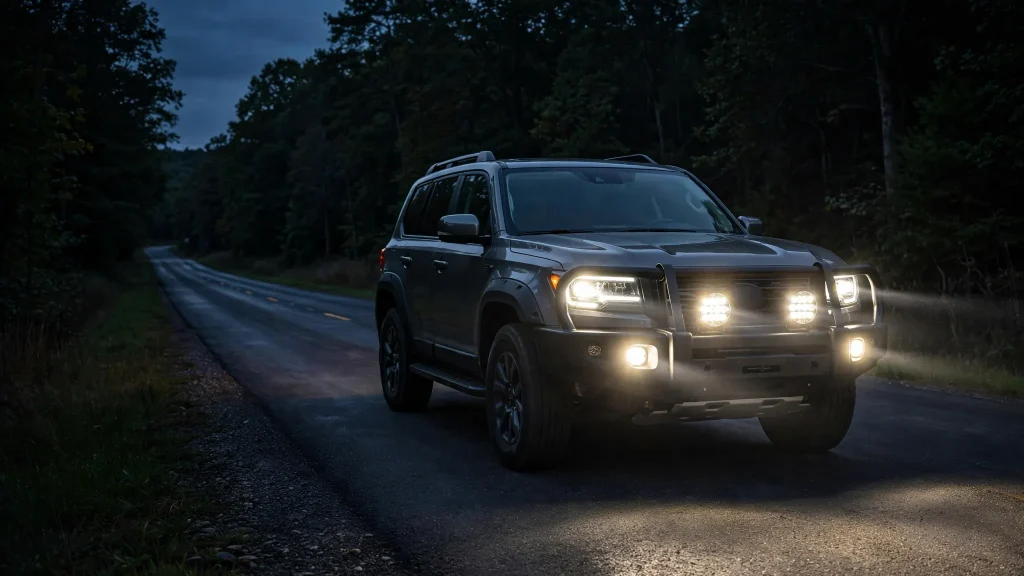
Auxiliary Driving Lights have become one of the most effective upgrades for drivers who regularly travel at night or in poor weather. Factory headlights often meet minimum legal standards, but they may not provide enough forward visibility on dark highways, rural roads, or off-road trails. Adding quality auxiliary lighting improves reaction time, helps identify hazards earlier, and reduces driver fatigue during long journeys.
Modern lighting technology has advanced significantly. Most premium auxiliary driving lights now use high-output LEDs that produce between 4,000 and 20,000 lumens while consuming less power than traditional halogen lamps. Many units also carry an IP67 or IP68 waterproof rating, making them reliable in rain, snow, mud, and dust. Proper installation remains just as important as choosing the lights themselves. Poor alignment or incorrect wiring can reduce performance and create safety risks for other road users.
In this guide, we explain everything you should know before installing Auxiliary Driving Lights. We cover the different light types, mounting options, legal requirements, wiring considerations, and maintenance tips. With the right knowledge, we can improve nighttime visibility while maintaining safe and legal road use.
Understanding Auxiliary Driving Lights
What Makes Them Different From Standard Headlights?
Auxiliary Driving Lights are additional forward-facing lights that work alongside a vehicle’s high beams. They extend illumination beyond the factory lighting system and improve long-distance visibility. Unlike fog lights, which produce a wide beam close to the road, driving lights project a concentrated beam farther ahead.
Modern LED systems deliver higher brightness while generating less heat than older halogen technology. Many premium models operate between 5,700K and 6,500K color temperatures, producing crisp white light that improves object recognition at night. Proper beam alignment prevents glare while maximizing usable distance.
Key benefits include:
- Improved nighttime visibility.
- Earlier hazard detection.
- Reduced eye strain during long drives.
- Better confidence on rural roads.
- Enhanced performance during off-road adventures.
| Feature | Standard Headlights | Auxiliary Driving Lights |
|---|---|---|
| Purpose | General driving | Extended visibility |
| Beam Distance | Moderate | Long-range |
| Brightness | Factory specification | Higher output |
| Activation | Low and high beam | Usually linked to high beam |
| Best Use | Everyday driving | Rural, highway, off-road |
Choosing the Right Auxiliary Driving Lights
LED, Halogen, and HID Comparison
Selecting the right Auxiliary Driving Lights depends on driving conditions and vehicle use. LEDs dominate today’s market because they combine efficiency, durability, and excellent light output. Many premium LED units exceed 10,000 lumens while drawing less current than comparable halogen lights.
Halogen lights remain affordable and easy to replace. However, they generate more heat and generally have shorter service lives. HID systems provide strong illumination but require ballasts and longer warm-up times. LEDs typically offer operating lifespans exceeding 30,000 hours, making them the preferred option for frequent drivers.
When comparing products, consider these specifications:
- Lumens instead of wattage.
- Beam pattern.
- Color temperature.
- Waterproof rating.
- Housing material.
- Warranty period.
- Vehicle compatibility.
A combination beam often delivers the best balance by providing both long-distance reach and wider roadside illumination.
Installation, Wiring, and Legal Requirements
Planning Before You Install
Correct installation determines how effectively Auxiliary Driving Lights perform. Most installations require a relay wiring harness, an inline fuse, weatherproof connectors, and a dashboard switch if local regulations allow independent control. Many manufacturers recommend connecting the lights through a relay triggered by the factory high beams.
Mounting location also matters. Bull bars, roof racks, front bumpers, and grille mounts all influence beam performance. Lower mounting positions generally reduce glare caused by dust, rain, and fog. Roof-mounted lights provide greater distance but often create more reflected glare in poor weather.
Before installation, check these important factors:
- Local lighting regulations.
- Maximum permitted number of lights.
- Required beam alignment.
- High-beam activation rules.
- Vehicle electrical capacity.
- Secure mounting hardware.
Many regions require auxiliary driving lights to switch off automatically when low beams are selected. Always verify local laws before completing the installation.
Maintenance Tips for Long-Term Performance
Keeping Your Lights Performing at Their Best
Regular maintenance helps Auxiliary Driving Lights deliver consistent performance for years. Dirt, road salt, insects, and oxidation gradually reduce light output. Cleaning lenses with automotive-safe products maintains brightness without damaging protective coatings.
Inspect wiring every few months for loose terminals, corrosion, or damaged insulation. Vibrations from off-road driving can loosen mounting brackets over time. Tightening fasteners during routine vehicle maintenance helps maintain proper beam alignment.
For the best results, we recommend:
- Clean lenses after long trips.
- Check mounting bolts regularly.
- Inspect wiring connections.
- Replace damaged seals immediately.
- Test beam alignment twice each year.
- Remove heavy mud before storage.
Drivers who regularly travel in harsh weather should perform inspections more frequently. Preventive maintenance protects both lighting performance and electrical reliability. Explore our latest insights in Everything You Need to Know About Upgrading to LED Headlights.
Conclusion
Installing Auxiliary Driving Lights is one of the most practical upgrades for improving nighttime driving safety and visibility. Choosing the correct beam pattern, selecting high-quality LED technology, following proper wiring practices, and complying with local regulations all contribute to better performance. Careful installation also protects your vehicle’s electrical system while preventing glare for other drivers.
With regular maintenance and accurate alignment, auxiliary driving lights deliver dependable illumination across highways, rural roads, and off-road environments, making every journey safer and more comfortable in challenging driving conditions.